.svg "collegewise-logo-100-100 (1)")

What Matters Most When Choosing a College: Parent vs. Student Roles
Summary:
A liberal arts college is a small, four-year undergraduate school that teaches a broad range of subjects—humanities, sciences, and the arts—instead of a narrow, vocational training program. A liberal arts degree (a B.A. or B.S.) builds transferable skills like writing, critical thinking, and communication that apply across many careers. Well-known liberal arts colleges include Williams, Amherst, Pomona, and Swarthmore.
Liberal arts colleges have faced headwinds for most of the last decade, as a broader trend prioritized STEM disciplines and practical, career-specific skills over the liberal arts. However, today’s fluctuating economic landscape and the pressures of artificial intelligence (AI) on entry-level jobs are shifting interest back toward liberal arts studies. With a growing appeal for interdisciplinary programs and the skills students develop from these studies, a liberal arts college education may be worth considering for future college applicants.
What is a Liberal Arts College?
A liberal arts college is a four-year institution that offers students an interdisciplinary undergraduate education across a broad range of arts and sciences disciplines, rather than narrow vocational training.
Some of the most common defining traits of liberal arts colleges are:
- Small-sized, private colleges that tend to enroll fewer students than large-scale, public institutions.
- Small class sizes that encourage discussion-based learning, instead of large lecture halls.
- Broad core curriculum where students take classes across multiple disciplines, often before declaring a major.
- A strong focus on soft skills alongside hard skills—communication, critical thinking, and adaptability that transfer across many fields of work.
What is a Liberal Arts Degree? Common Majors
A liberal arts degree is an undergraduate degree, typically a Bachelor of Arts (B.A.) or a Bachelor of Science (B.S.), earned by studying multiple academic disciplines rather than a single, specialized professional degree.
The 15 most common and popular liberal arts majors include:
- English and Literature
- Communication
- Education
- History
- Philosophy
- Psychology
- Humanities
- Political Science
- Economics
- Business
- Sociology
- Biology and other natural sciences
- Languages
- Art
- Music
The goal of a liberal arts education is to help students build transferable skills such as writing, research, critical thinking, problem-solving, and communication; skills that can be applied across many fields, including law, business, healthcare, education, and technology.
Note that a major like business looks different at a liberal arts college than at a specialized program. At a liberal arts college, business or economics sits inside a broad curriculum; at a dedicated business school, students often start professional coursework in their first year. If your student is weighing the two, compare them against the best college for business undergraduate programs.
Is a Liberal Arts Degree Worth It? 5 Ways Liberal Arts Prepares Students for Success
Here are 5 reasons a liberal arts degree is worth it:
1. Major flexibility and career versatilityLiberal arts students traditionally don’t have to declare a major until the end of their second year and often have the freedom to double major or add minors. That flexibility carries into their careers, too. Liberal arts graduates can pursue a wide range of fields and pivot more easily as circumstances change.
2. Prioritizes holistic learningA liberal arts education emphasizes experiential learning, practical engagement, and community involvement, all of which help students develop strong skills necessary to be successful. As more companies shift to skill-based hiring, demonstrated soft skills and real-world experience are paying off alongside, and sometimes more than, technical training.
3. Encourages innovation and creativity
At the heart of a liberal arts education is creative and critical thinking. By studying across disciplines, students learn to draw connections that single-track education might miss. This well-rounded framework encourages innovation and out-of-the-box thinking. Steve Jobs captured this idea when he said Apple’s products come from technology “married with liberal arts, married with the humanities.”
4. Generous financial aid and long-term affordability
Liberal arts colleges are often assumed to be pricier than public universities, but many offer some of the most generous need-based financial aid in the country. Berea College, for example, stopped charging students tuition in 1892.
5. Strong preparation for graduate school
Small classes and close faculty mentorship mean liberal arts students get more one-on-one guidance, research opportunities, and letters of recommendation that can be used toward graduate school.
Why Do We Need a Liberal Arts Education?
Today’s economic landscape has presented numerous challenges for college graduates. According to the Federal Reserve Bank of New York’s ongoing study, The Labor Market for Recent College Graduates, the unemployment rate for recent grads was about 5.7% in the first quarter of 2026.
Much of the conversation around recent graduate unemployment rates cites AI as the main culprit, since it has absorbed many of the entry-level tasks once handled by junior employees. But another perspective poses a different, more severe explanation: students are losing professional and interpersonal skills they need to be successful in the workplace.
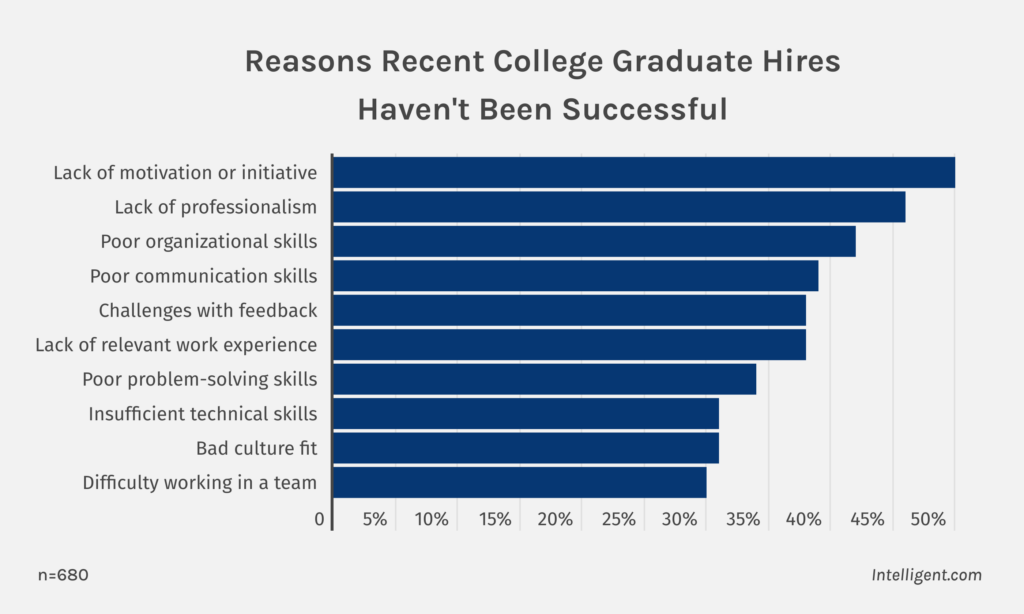
A 2024 Intelligent.com survey of 966 business leaders found clear signs of an underpreparedness gap:
- 75% of companies reported that some or all of their recent college graduate hires were unsatisfactory.
- 6 in 10 companies fired a recent college graduate they hired in the same year.
- 1 in 7 companies may stop hiring recent college graduates altogether.
- Only 25% of all recent college graduate hires worked out well.
The most common reasons cited for hires that didn’t work out were a lack of motivation or initiative (50%), a lack of professionalism (46%), and poor communication skills (39%).
Intelligent’s Chief Education and Career Development Advisor, Huy Nguyen, noted that many recent graduates struggle to adapt to less structured and autonomous work. “Although they may have some theoretical knowledge from college, they often lack the practical, real-world experience and soft skills required to succeed in the work environment.”
That’s exactly where a liberal arts education tends to build strength. The skills employers say they’re missing (communication, problem-solving, organization, and self-direction) are core outcomes of a broad, discussion-based liberal arts college curriculum.
6 Common Misconceptions about Liberal Arts Colleges
5 common misconceptions about liberal arts colleges are:
-
“Liberal arts colleges do not offer STEM disciplines.” Most liberal arts colleges offer a full range of STEM majors, including biology, chemistry, physics, mathematics, and computer science.
-
“Liberal arts colleges are not reputable schools.” Some of the most selective colleges in the country are liberal arts colleges such as Williams, Amherst, Swarthmore, and Pomona. Other highly selective institutions embrace a liberal arts foundation, such as Harvard, Yale, and Princeton.
-
“A Liberal arts education does not lead to job opportunities.” Several liberal-arts-adjacent majors post some of the lowest unemployment rates of any field in 2026, including special education (0.7%), foreign language and geography (1.6% each), and social services majors (1.9%).
-
“A liberal arts education won’t lead to high-paying jobs.” Starting salaries for computer science and engineering graduates are indeed higher on average than for many liberal arts majors. But long-term career success depends far more on the skills a student develops and how they apply them than on their major alone.
-
“AI will take over the jobs of liberal arts graduates.” AI still struggles with the kind of judgment, nuance, and human context that a liberal arts education is built to develop.
-
“Liberal arts colleges aren’t worth the investment.” Many liberal arts colleges have generous financial aid policies. Colgate University offers tuition-free attendance to any student whose household income is $175,000 or less. Many other liberal arts colleges offer substantial need-based aid, making higher education more affordable to students.
15 Best Liberal Arts Colleges
Here’s a list of the 15 best liberal arts colleges that offer distinct learning opportunities and are known to help students develop key skills.
- Williams College
- The Claremont Colleges
- Lawrence University
- Colgate University
- Goucher College
- Colorado College
- St. John’s College
- Smith College
- Berea College
- Reed College
- Amherst College
When comparing colleges, look beyond name recognition and evaluate what each college offers. Consider:
-
Cost of attendance. Does the school offer need-based aid or scholarship opportunities?
-
Academic opportunities. What courses, research opportunities, and real-world experience can you receive at that institution?
-
Location and setting. Rural, small-town, and urban liberal arts colleges offer very different day-to-day experiences.
-
Networking opportunities. Alumni networks and available internships.
-
Outcomes. Graduate school acceptance rates, workplace placement, and career services.
Should You Consider a Liberal Arts College?
At Collegewise, we’re big believers in college fit. Choosing between a liberal arts college and a research university comes down to how you want to learn and live for four years.
If small classes, tight-knit campuses, close faculty mentorship, and holistic learning matter to you, a liberal arts college may be the right fit.
If having a longer runway or exploration before committing to a major makes more sense academically and financially, then a liberal arts college may be a solid choice.
Is a Liberal Arts College Right For My Student? A Quick Assessment
Definitions only go so far. Parents and students can talk through these questions together; the more "yes" answers, the stronger the case for putting liberal arts colleges on your college list.
Consider these questions:
-
Do they do their best work in discussion or taking notes in a lecture hall/self-studying?
-
Would they rather blend into the crowd or be known by their professors?
-
Do they enjoy writing and discussing a point?
-
Are they still deciding on a major, or are they interested in more than one field of study?
- Are they comfortable in a small-town or rural setting, or would they need easy access to a city?
- Would they prefer a small-sized classroom or a big lecture hall-style academic environment?
How Liberal Arts Colleges Review College Applications
Applying to a liberal arts college is not the same as applying to a large university. Smaller applicant pools mean admissions officers can read each file more closely. It also means that reviewers are curating an intentional list of incoming students because of the small community they're building. This can significantly change what matters to colleges and why.
Essays carry real weight. At large institutions, test scores and GPA often do much of the early sorting. At liberal arts colleges, your essays are one of the main ways readers get to know the applicant, their interests, and intentions in college.
Intellectual curiosity matters. Liberal arts colleges are looking for students who want to learn because they're passionate about something. These are students more likely to contribute to discussion and the community on campus.
Qualitative application components have higher weight. Letters of recommendation, essay responses, demonstrated interest, and interviews are all part of the holistic review process that most liberal arts colleges implement as part of their admissions process.
Overall, a liberal arts college can be a great fit for the right student, and with the right application, admissions officers can see that fit, too. If your student is interested in applying to a liberal arts college or may be considering a liberal arts education, we can help your family build a college list or tell their story in an impactful way. Schedule a free consultation today to learn more about our counseling for liberal arts pathways.
/Emora%20Health%20Blog%20Design%20CTA.png?width=600&height=180&name=Emora%20Health%20Blog%20Design%20CTA.png)
.png?width=500&height=500&name=landing%20page%20(92).png)
.png?width=500&height=500&name=landing%20page%20(62).png)