.svg "collegewise-logo-100-100 (1)")


USC Acceptance Rate (2026) & 5 Expert Tips to Get Accepted
Last updated on August 10, 2026.
Quick answer:
New York University (NYU)’s overall acceptance rate is 9.0% for the most recent, completed admissions cycle (Class of 2029), placing it among the most selective universities in the country. The transfer acceptance rate is considerably higher at 38.6%. And with a yield rate of 55%, more than half of those accepted end up enrolling on campus. NYU has not yet published full admissions data for the Class of 2030 (2026 cycle), but historical data points to another year of competitive applications.
Numbers at a glance:
|
Overall (2025) 9.0% |
Transfer (2025) 38.6% |
Yield (2025) 55% |
Why is NYU's acceptance rate different everywhere?
If you've searched around, you've probably seen NYU's acceptance rate reported anywhere from 7.7% to 28%. Here's why sources disagree:
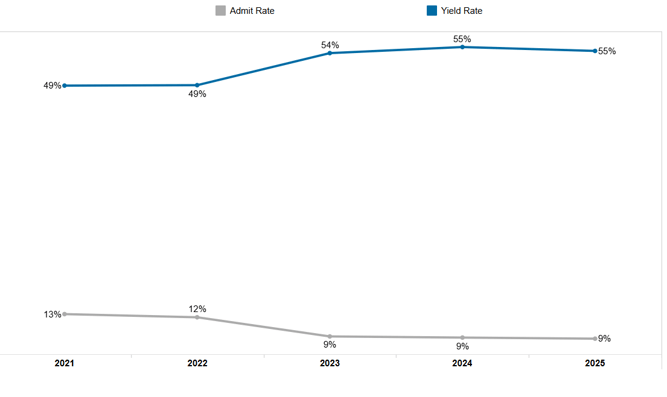
Few pages report a 28% acceptance rate, but this figure is outdated. NYU has admitted close to a third of applicants as recently as 2021 (see figure below).
NYU's acceptance rate being 8-9% refers to the preliminary rate on decision day, which may look different than official, audited reports provided in the Common Data Set.
Some cites are reporting enrollment, not acceptance rate. The admit rate (accepted students ÷ number of applicants) and yield/enrollment rate (enrolled students ÷ admitted students) produce different numbers and may sometimes be mislabeled.
Some pages receive refreshes at different times of the year and may be reflecting outdated data that has yet to be updated for this most recent class.
This page's numbers are pulled from the NYU's official Common Data Set filings, not press releases or third-party aggregation.
How selective is NYU?
With an acceptance rate of 9.0%, NYU rejects more than 90% of its applicants. This level of selectivity puts it in the same tier as several Ivy League institutions. But that wasn’t always the case: in 2022, NYU admitted roughly 13% of applicants. Collegewise counselor and former NYU application reader, Gretchen Gleason, points to application volume as the main culprit. “From what I understand, NYU has not changed enrollment numbers. So it really does speak back to application numbers being on the rise. The college is consistently receiving 100,000+ applications every year.”
A significant factor driving that surge is NYU’s growing reputation beyond its art roots. “Stern (Business) and Engineering (Tandon) have both continued to climb rankings,” Gleason notes. “Stern is now up there with Wharton and with Ross at Michigan. People used to consider NYU as just the drama school, but they’ve really nailed engineering and business now.”
Part of what makes NYU’s admissions picture so complex is its structure. NYU has 10 undergraduate schools, each with its own admissions process and acceptance rate. Three of these—Stern (Business), Tandon (Engineering), and the College of Arts and Sciences—have acceptance rates below 5%, ultimately dragging the overall figure down to the single digits.
What is NYU’s acceptance rate by year?
According to NYU’s external admissions data from 2018-2025, the acceptance rate has steadily declined. Full data for the Class of 2030 (2026 cycle) has not yet been published.
|
NYU Applications Received |
NYU Students Admitted |
NYU Acceptance Rate |
|
|
2026 (Class of 2030) |
Not Yet Published |
Not Yet Published |
Not Yet Published |
|
2025 (Class of 2029) |
114,125 | 10,340 | 9.0% |
|
2024 (Class of 2028) |
110,807 | 10,232 | 9.2% |
|
2023 (Class of 2027) |
113,578 | 10,693 | 9.4% |
|
2022 (Class of 2026) |
100,662 | 6,184 | 12.4% |
|
2021 (Class of 2025) |
95,517 | 12,380 | 12.9% |
|
2020 (Class of 2024) |
80,210 | 16,918 | 21.0% |
|
2019 (Class of 2023) |
79,462 | 12,873 | 16.2% |
|
2018 (Class of 2022) |
71,834 | 14,359 | 20% |
|
Table 1: NYU’s acceptance rate by year, 2018–2026. Source: NYU External Reporting Admissions Data. |
|||
Collegewise's NYU acceptance rate for the last five years has been 33%, a whopping 24% higher than NYU's 9.0% acceptance rate. Collegewise students are 12x more likely to be admitted to NYU than the general applicant.
/NYU%20CTA.png?width=621&height=186&name=NYU%20CTA.png)
NYU class profile (2025-2026)
According to NYU's 2025-2026 Common Data Set, the admitted student class profile includes:
| Metric | Range |
| SAT (middle 50%) | 1480-1550 (median ~1520) |
| ACT (middle 50%) | 34-35 (median 34) |
| Average GPA | 3.81 |
| GPA 3.75-3.99 | 54.7% of admits |
| GPA 4.0 | 18% of admits |
| SAT submission | 38% of admitted students |
| ACT submission | 10% of admitted students |
| Table 2: NYU’s Class of 2029 Class Profile. Source: NYU Common Data Set 2025-2026. | |
What is NYU’s transfer acceptance rate?
NYU’s transfer acceptance rate is 38.6% for the most recent cycle. This marks a considerably more favorable number than the 9.0% rate that first-year applicants face. That said, transfer admissions at NYU are still highly competitive, with over 10,000 transfer applications received annually.The transfer acceptance rate has also fluctuated significantly year-over-year. In 2023, it was 27%, down to 22%, and now back to 38.6% in 2025, making it a risky gamble for interested applicants.
|
NYU Transfer Applications Received |
NYU Transfer Students Admitted |
NYU Transfer Acceptance Rate |
|
|
2026 (Class of 2030) |
Not Yet Published |
Not Yet Published |
Not Yet Published |
|
2025 (Class of 2029) |
10,681 | 4,128 | 38.6% |
|
2024 (Class of 2028) |
10,155 | 2,243 | 22% |
|
2023 (Class of 2027) |
10,573 | 3,930 | 37% |
|
2022 (Class of 2026) |
8,361 | 1,712 | 20.4% |
|
2021 (Class of 2025) |
9.042 | 2,337 | 25.8% |
|
2020 (Class of 2024) |
7,906 | 3,279 | 41.4% |
|
2019 (Class of 2023) |
8,510 | 1,863 | 21.8% |
|
2018 (Class of 2022) |
8,138 | 2,004 | 24.6% |
|
Table 3: NYU’s transfer acceptance rate by year, 2018–2026. Source: NYU Common Data Sets 2018, 2019, 2020, 2021, 2022, 2023, 2024, and 2025. |
|||
What is NYU’s yield rate?
NYU’s yield rate—the percentage of admitted students who enroll—has held steady at 55% for the past two cycles. That figure means that more than half of the students NYU sends acceptance letters to show up on campus.
NYU’s yield was 49% in 2022, when it was accepting 12% to 13% of applicants. As admissions tightened, yield climbed. This pattern is common among selective colleges, especially as students begin to view these colleges (and NYU today) as a top choice rather than a backup.
Does applying Early Decision to NYU increase your odds of acceptance?
Over 25,000 students applied Early Decision (ED) to NYU in the 2025-2026 application cycle. While NYU has not released its ED acceptance rates, colleges that offer early options tend to have higher acceptance rates than Regular Decision (RD) in January. Why? Colleges reward students who apply ED because of its binding commitment.
“It is a guarantee for them that you’re coming - at least 90%, which is a much stronger return than just regular decision. The admit rate in ED certainly looks very different,” says Gleason. “If I had to guess, it likely sits between 30% and 35%, and it does carry quite a bit of weight in the admissions process.” For students aiming for NYU, facing an acceptance rate in the double digits could give them more breathing room than the general 9%.
For this reason, applying to NYU early can be a great strategy for students. It demonstrates interest and signals real commitment to colleges. When colleges see this (assuming a student meets or exceeds the requirements to attend), they feel more confident extending an offer.
NYU offers two early decision options: ED 1 and ED 2. ED 1’s deadline is November 1st, allowing students to receive their decisions before the ED 2 or RD deadlines, both in early January.
For those students considering applying to NYU through the ED option, it isn't just a question about whether you believe this college is the right fit for you; it also becomes a question about finances. If admitted, you're committed to attending, regardless of the financial aid offer, and without the option to compare it against other offers. With NYU's costs of attendance rising each year, we encourage students and parents to consider all college application deadlines and the financial implications that come with each option.
The upside to applying ED to NYU is that under The NYU Promise, families will have 100% of their demonstrated financial need met, and families with a household income of $100,000 or less will not be expected to pay tuition.
Given that a larger number of students are likely admitted through ED, this may be the right choice forward, but it's worth considering the strengths and limitations as a family first.
How much is NYU's tuition?
The cost of attendance and tuition at NYU are very different figures. According to the NYU Bursar, NYU's tuition and fees for 2026-2027 are $68,576/year for most undergraduate schools. However, tuition and total cost of attendance—housing, food, books, and personal expenses—can vary considerably. NYU's total cost of attendance is between $100,998 and $107,748 for 2026-2027. This sticker price is not necessarily what most families end up paying. This cost assumes no financial aid at all, and with NYU's new financial aid policies, this figure may change for some families.
When determining college costs, here are three numbers to know the difference between:
| Defintion | Total (USD) |
| Base price/tuition and fees | ~$68,576/year |
| Sticker price/cost of attendance | $100,998 - $107,748 |
| Net price / what a family actually pays | Sticker price minus grants and scholarships |
Before assuming the sticker price, be sure to reference NYU's official Net Price Calculator to understand what financial aid package your family may be eligible to receive.
Is NYU a good school for me?
NYU is a great college, but college fit isn’t universal. Fit is not just something students should consider; it’s also top of mind for colleges. Does this student belong at NYU? That’s the question colleges are asking, and that’s the question students should ask themselves while conducting college research.
“NYU is a very global institution, and they are very proud of that,” says Gleason. “You have to be curious about the world and how that plays in and is built into the curriculum.” Since its global expansion, NYU has four-year programs in Abu Dhabi, Shanghai, and New York, as well as robust study abroad options. This global piece is certainly something students should consider when applying to NYU; it’s also one of the key things that NYU may look for in a student’s application. How and where a student has exposed themselves to different cultures, a global perspective, study abroad options, and more.
“It’s a school where I am going to encourage every student to visit, because it either works for you or it doesn’t,” Gleason notes. “It doesn’t have a quad; it does not have that community feel; the football games on Saturday don’t exist. But you do have New York City at your disposal.”
At Collegewise, we encourage students to spend more time than they think they need to on researching colleges. Identifying their academic wants and needs, and also what they don’t want from a college experience. Through this research, students can start to identify which colleges are the right fit for them and if NYU, in particular, makes that shortlist.
Questions parents can be asking:
-
Does your teen want a traditional campus quad, or is NYC's "the city is your campus" model a better fit?
-
Are study abroad programs important to your teen?
-
Does your teen have an independent, highly driven spirit?
-
What kinds of networking opportunities does your teen want access to, and does NYU have them?
-
What does your teen want to major in and how do NYU programs compare to other institutions?
-
What factors does your teen consider important to making their college experience memorable? (e.g., food, tight-knit environment, etc.)
-
If your family is not eligible for NYU's financial aid or scholarships, are you prepared to pay the full four-year cost?
What this means for families planning ahead
For parents with teens applying in the upcoming cycle, NYU's most recent acceptance and class profile will directly impact their admissions results. Here are a few things to keep in mind:
-
Discuss your ED strategy and financials as a family before application season hits. ED is binding, which means the strategy and money need to be decided together.
-
Compare your teen's academic transcript to NYU's class profile listed in this blog. Understand cutoffs, baselines, and where your teen sits compared to previously admitted students.
If your child is in 9th or 10th grade now, what matters more than the acceptance rate today is where the trend is headed by the time they apply. NYU's applicant pool has grown by nearly 60% in the last eight cycles. A student applying in two or three years from now should expect a more competitive environment than today's numbers show. Here are a few tips you can start implementing today:
-
Research NYU and understand the different schools, cost, campus culture, and opportunities in advance. NYU's unique campus culture and school structure may not be the right fit for all students. Give your teen enough time to do the research, identify a likely major, and understand what acceptance rate they could face should they choose to apply.
-
Help your teen build an academic profile that matches the schools they're interested in. Getting into NYU (or any other highly selective institution) requires years of strategic planning. The earlier a target school is identified, the more time a student has to craft an intentional college application.
-
Decide on a testing strategy early. For test-optional schools, not submitting a bad test score won't diminish their chances of acceptance, but submitting a strong test score may tip the scales. Give your teen enough time to take diagnostic tests, build a prep timeline, and retest if they need to.
Frequently asked questions
The Bottom line
Getting into NYU demands more than just a strong academic transcript from students. It requires students to think carefully about every component of their application: essays, extracurriculars, and demonstrated interest. Getting accepted into NYU will take the same dedication as getting accepted into the Ivy League or other highly selective colleges.
When asked about what students should consider beyond building out a strong academic portfolio, Gleason suggests: “To an applicant, it’s really understanding and being able to articulate to NYU what specifically about the college resonates with you. Why is their program interesting to you? If you went there, where would you go abroad, and why? Understand what they prioritize and identify ways to weave that into your application.”
How Collegewise can help
Our targeted 1:1 college counseling offers families strategic college planning, admissions support, essay coaching, financial consulting, and extracurricular enhancement opportunities all blended into one trusted service. Our holistic approach to college counseling prioritizes building the whole student to ensure they not only receive a college acceptance, but the confidence to excel in their post-secondary education. Collegewise's "Hive Mind" gives students a blend of personalized college counseling and the expertise of over 130+ former admissions officers, application readers, and educational professionals.
Learn more about how Collegewise can help your teen craft a compelling NYU college application. Start with a free consultation.
/Emora%20Health%20Blog%20Design%20CTA.png?width=600&height=180&name=Emora%20Health%20Blog%20Design%20CTA.png)
/bdabney-tillman-hall-5316095_1920.jpg?width=500&height=500&name=bdabney-tillman-hall-5316095_1920.jpg)