.svg "collegewise-logo-100-100 (1)")


What is Holistic Admissions? Meaning, Process, and How Colleges Decide
The terms "valedictorian" and "salutatorian" get used a lot, but the distinction between them (whether either title actually matters for college admissions) isn't always clear. We'll break down what each title means, how they compare, and whether they're still worth chasing in 2026.
Key Takeaways:
-
A valedictorian is the top-ranked student in a graduating class, recognized for achieving the highest level of academic performance. Schools may award the valedictorian honor based on GPA, course rigor, teacher consideration, or some combination of these factors.
-
The difference between valedictorian and salutatorian is primarily in the class rank. Valedictorians are ranked #1 in their graduating class, and salutatorians are #2.
-
Will being a valedictorian get a student accepted to college? No. Fewer schools are prioritizing class rank due to growing competition, a holistic review process, and the nuance in class rankings between schools.
What is a Valedictorian?
A valedictorian is a student who is recognized as having the highest academic standing in their graduating class, including their cumulative grade point average (GPA) and academic awards. It is typically bestowed on a senior student, who is then expected to deliver a valedictory (farewell) speech at their graduation ceremony. Not every school will have a valedictory speech, which is based on the school’s traditions. Regardless, being named valedictorian remains a universally recognized mark of exceptional academic achievement for any high school student.
Valedictorian status not only reflects academic performance but also demonstrates a student’s dedication and sustained commitment to their studies. It’s not just the title that’s impressive; it’s what it represents.
Related: What is a Weighted or Unweighted GPA? Which Do Colleges Care About?
Valedictorian vs. Salutatorian: How Do They Compare?
|
Honor |
Class Ranking |
GPA Basis |
Typical Role at Graduation |
|
Valedictorian |
#1 in graduating class |
Highest cumulative GPA (weighted or unweighted, depending on school policy) |
Presents the closing speech. |
|
Salutatorian |
#2 in graduating class |
Second-highest cumulative GPA |
Presents the opening speech. |
Both titles reflect strong academic standing and a demonstrated work ethic. Whether a student is named valedictorian or salutatorian, colleges recognize either as one of the highest achievements a student can earn over four years of high school.
Why High Schools Use These Titles and How They Differ From School to School
High schools award class valedictorian and salutatorian designations as a way to recognize the dedication and achievements of students. Still, the meaning can differ depending on the high school. At some schools, the valedictorian is simply the individual with the highest GPA. At other schools, they may consider academic awards or the number of Advanced Placement (AP) or International Baccalaureate (IB) courses a student takes. Because of these nuances, colleges often consider context over just the title. Colleges take into consideration the traditions and rules surrounding valedictorian awards that high schools have in place, and factor that into their decision-making process.
Does Valedictorian Status Matter for College Admissions?
It depends on the type of school and how the application is reviewed.
-
State schools and public universities with formula-based admissions (common in Texas, Florida, and California's UC system) may weigh class rank directly and offer guaranteed admission to top-ranked students from in-state high schools.
- Selective private colleges with holistic review treat valedictorian status as one data point among many. Admissions officers know "#1 in class" means very different things depending on a school's size, course offerings, and ranking methodology, so the title alone carries only some weight.
- Scholarship considerations are often where the title pays off most concretely, since many merit scholarships explicitly list valedictorian or top-decile rank as a qualifying criterion.
Will Being a Valedictorian Guarantee College Acceptance?
No, being a valedictorian does not guarantee acceptance into a college, even if it’s the highest honor for a high school student. The better question here is: Do colleges care about a valedictorian title? The short answer is, it depends on the college. For colleges that only consider academic performance, it can improve the student’s odds against other applicants. For prestigious or highly selective colleges, deciding whether or not a student is the right candidate for their college is based on much more than just academic performance. So, while colleges recognize this as a great achievement, if a student does not have strong extracurriculars, show demonstrated interest, or submit thoughtful college essays, they may likely be passed over.
Why? The reality is, there are more valedictorians and salutatorians in the United States than there are available spots at colleges. To illustrate this point further, see the chart below from the most recently completed graduation cycle.
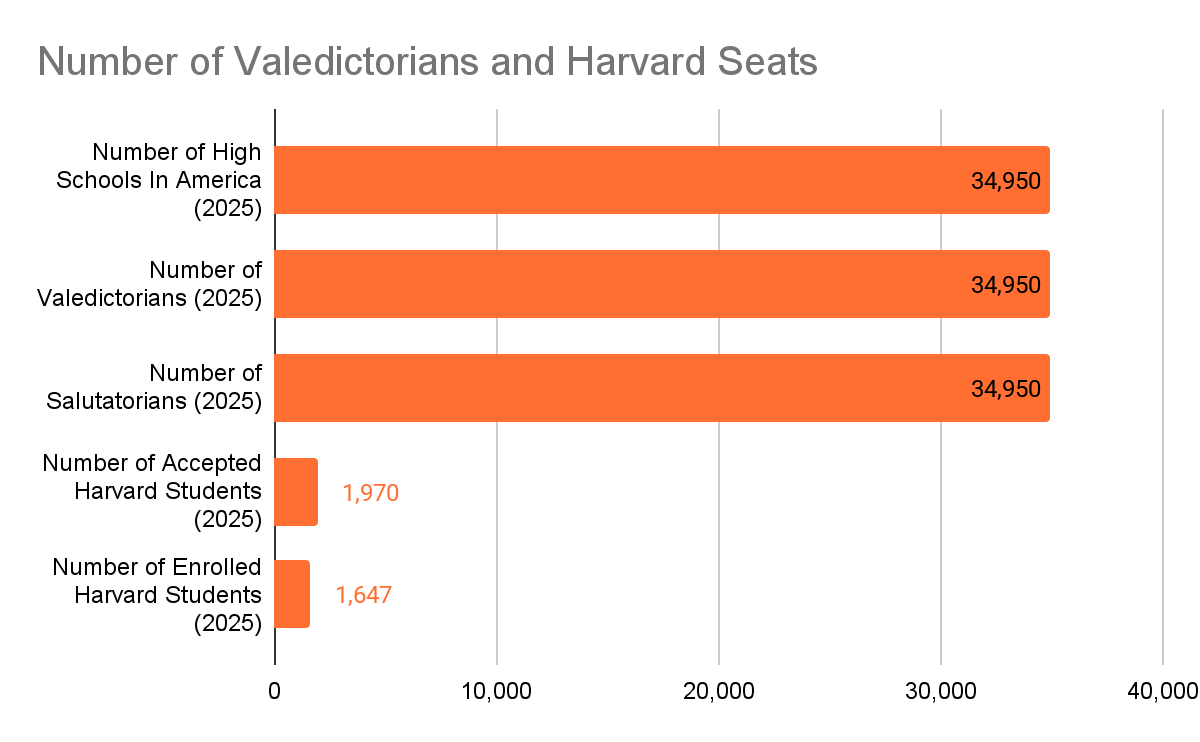
Using Harvard University as an example, it’s clear that the number of valedictorians and salutatorians significantly exceeds the number of available seats Harvard has for its incoming freshman class. While most valedictorians can likely operate at a Harvard level and have the grades to prove it, the reality is that being valedictorian cannot be the only factor colleges consider, especially with the volume of applications received annually.
So, will being valedictorian get a student into college? No, but it’s still a meaningful goal to strive for. It’s an honorable distinction that reflects hard work and is considered part of a student’s overall application.
Is Being a Valedictorian Worth it in 2026?
Yes and no. While the valedictorian title carries prestige, it can come at a cost for some students. Academic burnout and mental health challenges are risks. If it is sustainable for a student to obtain the valedictorian title, then it is a great goal to strive toward. However, if a student must adopt unhealthy habits to achieve it, it may be better to focus on simply being a well-rounded student.
Ultimately, students shouldn’t strive for valedictorian honors simply to boast about their recognition. Instead, they should consider the important characteristics and milestones that go into achieving this accomplishment and how that sets them up for future success.
Common characteristics of valedictorians include:
- A strong work ethic and time management skills
- A love of learning and a desire to challenge themselves
- Strong leadership abilities and initiative
Being named valedictorian is still a fulfilling goal, but students (and parents) should assess the “why” first and foremost.
The Bottom Line
In 2026, being a valedictorian is not the single defining marker for success, but it is still a great achievement for students. When you search “valedictorian meaning,” you’ll find a simple definition. But behind the title are years of academic commitment, hustle, grit, and leadership.
Ultimately, the title matters less than what it represents. Whether a student is a valedictorian, salutatorian, or honor roll student, what truly stands out is the dedication, resilience, and readiness for college that admissions officers value most.
Are you looking to improve your college acceptance chances? Start the conversation with Collegewise’s nationally-recognized 5-star counseling team by booking a free consultation today. Take the first step in learning more about our programs, personalized counseling, and how we’ve helped 30,000+ students gain admission to their top-choice schools.
/Free%20Collegewise%20Events%20(1).png?width=621&height=186&name=Free%20Collegewise%20Events%20(1).png)
About Us: With more than 26 years of experience, Collegewise counselors and tutors are at the forefront of the ever-evolving admissions landscape. Our work has always centered on you: the family. And just like we’ve always done, we look for ways for your student to be their best self - whether in the classroom, the applications, or in the right-fit college environment. Our range of counseling, test prep, academic tutoring, and essay management, all with the support of our proprietary platform, lead to 4x higher than average admissions rates.
/pexels-silverkblack-36812792.jpg?width=500&height=500&name=pexels-silverkblack-36812792.jpg)
/NYU%20stock%20image.jpg?width=500&height=500&name=NYU%20stock%20image.jpg)