.svg "collegewise-logo-100-100 (1)")


Dual Enrollment Pros & Cons, How it Works, and Rules by State
Summary:
Class rank is one way colleges evaluate academic performance, but it is not the only factor. If your high school does not track class rank, leave the field as "None." While class rank reporting matters for certain automatic admissions programs and scholarships, colleges typically use it as just one piece of a holistic review, so students from non-ranking schools are not at a disadvantage.
What is Class Rank Reporting on the Common App?
Class rank reporting is how a high school tells colleges where a student's GPA places them in their graduating class. On the Common App, the counselor reports it as an exact rank, a decile, quintile, or quartile, or none.
If you’ve spent time poking around the Common App, you’ve probably noticed questions about class rank. Not every high school ranks its students. If yours doesn't, it’s understandable to feel a small jolt of panic. Are you at a disadvantage? Should you be reporting something?
You're not, and you shouldn't. Below, we'll cover where rank carries real weight, the exact options the Common App gives your school, what "ranking weighting" means, and what to do if your school doesn't rank at all.
What is Class Rank?
Class rank is a measure of how your grade point average (GPA) compares to everyone else in your graduating class.
Schools calculate it from either weighted or unweighted GPAs. Unweights GPAs treat every class the same. Weighted GPAs give extra points for more challenging courses, such as AP, IB, or honors.
The student with the highest class rank is typically awarded the title of valedictorian, followed by the salutatorian in second place.
What Do Colleges Do With Class Rank?
Most colleges treat rank as one data point. In a few places, though, it can decide the outcome on its own.
Texas automatic admission. Texas law guarantees eligible in-state students who graduate in the top 10% of their class admission to Texas public universities. The University of Texas at Austin sets a tigher cutoff: it will automatically admit Texas students in the top 5% of their graduating class for the summer/fall 2027 and spring 2028 cycles.
University of California ELC. The University of California (UC) system is another common example of where class rank holds considerable importance. Through the Eligibility in the Local Context (ELC) program, students who place in the top 9% of their graduating class can qualify for a guaranteed spot somewhere in the UC system. UC calculates the top 9% from GPA in UC-approved courses, so ELC works even at California schools that do not report class rank.
Scholarships. Select scholarship opportunities are reserved for valedictorians and salutatorians. For example, Burman University offers students a one-time $3,000 scholarship to any valedictorian located in Canada, the United States, Bermuda, or the Bahamas who is granted admission to its institution.
How is Class Rank Reported on the Common App?
Your school counselor reports rank on the Common App school report, choosing one of five options. You'll also see a class rank question in the Education section of your own college application; match it to what your school uses.
| Your school reports | Example | What colleges see |
| Exact | 12th of 410 | Your precise position |
| Decile | Top 10% | The tenth of the class you fall in |
| Quintile | Top 20% | The fifth of the class you fall in |
| Quartile | Top 25% | The quarter of the class you fall in |
| None | No rank | A blank rank, plus your school profile, GPA, and course rigor |
On later forms, such as the final report, counselors can also note how many other students share your rank.
The Grades section of the Common App also asks applicants for context that helps colleges read your rank, or the lack of one:
- Graduating class size (approx.)
- GPA scale and GPA weighting
- Cumulative GPA
If your school calculates both a weighted and an unweighted GPA, the Common App asks you to report the weighted one.
What is Rank Weighting on the Common App?
Rank weighting tells colleges whether your school calculates class rank from a weighted or unweighted GPA. The Common App gives two choices: Weighted or Unweighted.
The difference can move a student several places. Take two students with straight A's. One took six AP courses, the other took none. On an unweighted scale thy tie at 4.0. On a weighted scale, the student with the AP courses ranks higher.
What to do with rank weighting?
- Report what your school uses. Your transcript or school profile will typically state what weighing system your school uses. If it doesn't, ask your counselor to be sure.
- Use weighted if your school does both. Always use weighted GPA if your school uses both systems to account for course rigor.
For more on how the two scales work, see our guide to weighted vs. unweighted GPA.
How Do I Find My Class Rank?
Class rank will be listed on the official high school transcript. If a class rank is not listed on your official transcript, your high school likely does not participate in class ranking practices.
What if My School Doesn’t Track Class Rank?
Recent data shows that a large share of high schools have stopped ranking students altogether. According to the National Association for College Admission Counseling (NACAC), more than 50% of high schools no longer report rankings. Given how many schools are removing or phasing out class rankings, students who do not have a rank to report are not at a disadvantage.
Admissions officers assigned to specific regions are familiar with the class rank policies of the schools from which they review. Before receiving annual college applications, school counselors send a “school profile” to college admissions officers. This profile describes a school’s grading system, course offerings, and grade distribution. When admissions officers do not have a class rank report, they rely on the context we’ve listed above and can infer where a student ranked in their graduating class.
Where Class Rank Matters Less: Holistic Review
Where it Doesn’t Matter: Holistic Review
At the most selective colleges, class rank is one data point in a larger picture. Admissions officers have shifted their focus to consider “accomplishment in context” more than class rank. That refers to what you did with the opportunities your school offered. Rank is one way to measure that, alongside your courses, grades, essays, and activities.
Take the University of Pennsylvania’s (UPenn) as an example. Its 2024-2025 Common Data Set lists class rank among the academic factors it considers, but it is not the most important one.
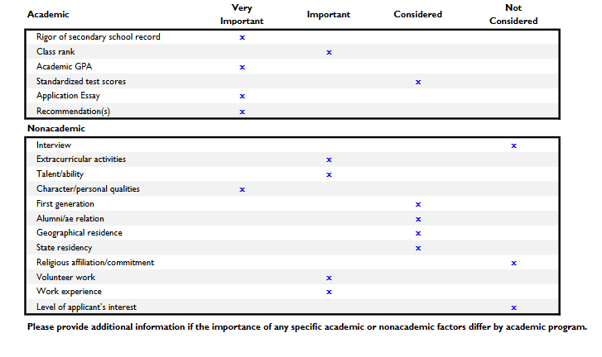
Nationally, rank has been losing weight for years. In NACAC's Fall 2023 survey, about 5% of four-year colleges rated class rank as of considerable importance.
For a deeper look at how colleges weigh everything together, see what holistic admissions means.
For Parents: When Your Student's School Doesn't Rank
Many high schools have stopped ranking students, and colleges are accustomed to it. A student without a rank is not at a disadvantage in holistic review.
Regional admissions officers know the schools they read for, and colleges receive each high school's school profile describing the grading system, courses offered, and grade distribution before application season. With the profile, your student's GPA and the class size, the college can place your student in context without a class rank.
What to do with your teen instead:
- Make sure your student selects "None" on the Common App and doesn't estimate rank.
- Focus on strategic course selection instead. Academic rigor shows up on the transcript whether or not the school ranks.
- Connect with your student's counselor to understand how your family can handle auto-admit, rank-based programs, or scholarships without having class rank.
Worried about how your student's class rank reads? A Collegewise counselor can walk through your student's transcript, school profile, and college list with you. Talk to an advisor today.
Common Mistakes about Class Rank Reporting
1. Don’t estimate your own rank.
If your school does not rank, leave it as “none.” Guessing or inventing a rank that does not align with your school transcript can be flagged as falsified information.
2. Don’t confuse weighted and unweighted GPAs.If a school calculates both weighted and unweighted GPA, report the weighted one. Getting this wrong can create inconsistencies between what is reported on the Common App and what is listed on your official school transcript.
3. Don’t stress too much about not having a class rank to report.
Colleges have long since adapted to the growing number of high schools that do not track class rankings. A student’s job when filling out their college application is simple: be honest, consistent, and let your academic performance shine in other areas.
Does Class Rank Matter?
Sometimes class rank matters a great deal, and often it matters less than students fear. Rank can decide automatic admission at places like UT Austin and unlock certain scholarships. But at most selective colleges or private institutions, it's one factor among many.
Rath than chasing or protecting rank, focus on taking courses you're passionate about and that demonstrate intellectual curiosity, healthy hustle, and college readiness.
/Emora%20Health%20Blog%20Design%20CTA.png?width=600&height=180&name=Emora%20Health%20Blog%20Design%20CTA.png)
%20in%20High%20School%20Coursework.jpg?width=500&height=500&name=Fail)%20in%20High%20School%20Coursework.jpg)
%20in%20High%20School%20Coursework-1-1.jpg?width=500&height=500&name=CreditNo%20Credit%20(a.k.a.%20PassFail)%20in%20High%20School%20Coursework-1-1.jpg)